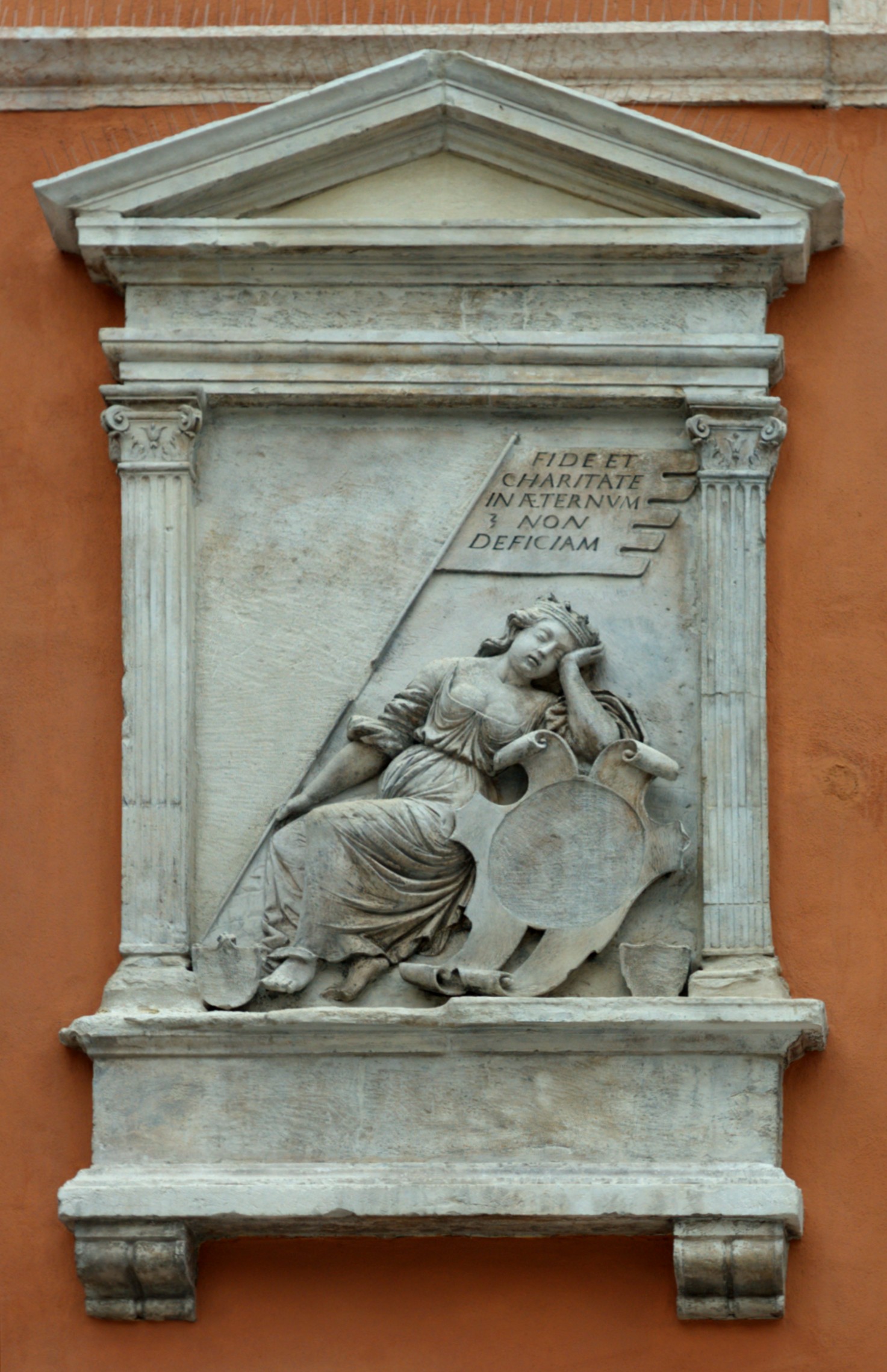
Seamos jardineros mientras podamos


“Todos los jardineros viven en lugares hermosos, porque los convierten en hermosos”, escribió Joseph Joubert. Es importante añadir, sin embargo, que los jardineros únicamente en contadas ocasiones disfrutan esos lugares como hermosos, porque tienen que estar trabajando en ellos todo el tiempo: si por un momento abandonasen sus tareas para dedicarse a la contemplación, pronto dejarían de ser los jardines hermosos y ellos, jardineros. Han de percibirlos siempre como deficientes, incompletos, fracasados, prestando atención continuamente a las composiciones ingratas que han de ser reformadas. El arte, la filosofía, la verdad, la libertad, como los jardines, son acción pura, y es imposible realizar beneficios del tiempo y energía que se invierten en ellos, porque para eso su curso debería ser detenido y, como consecuencia, dejarían de ser.

Let’s be gardeners whilst we prune

‘All gardeners live in beautiful places, because they make them beautiful,’ wrote Joseph Joubert. It is important to add, however, that gardeners only rarely enjoy these places as beautiful, because they have to be working in them all the time: if for a moment they were to abandon their tasks to devote themselves to contemplation, the gardens would soon cease to be beautiful and they would cease to be gardeners. They must always perceive them as flawed, incomplete, or unsuccessful, paying constant attention to the unattractive arrangements that need to be reworked. Art, philosophy, truth and freedom, like gardens, are pure action, and it is impossible to reap the benefits of the time and energy invested in them, because to do so their course would have to be halted and, as a result, they would cease to exist.

Los más lentos de los rápidos

Hay quienes nunca son engañados, astutos siempre alerta, siempre tienen la respuesta correcta en la punta de la lengua, cuando alguien trata de humillarles o de aprovecharse de ellos.

¿Qué significa estar preparado para responder? Tendría unos veinte años, cuando fui con un amigo a una tienda de electrodomésticos de Logroño a comprar una bombilla de luz negra, de esas que se usaban en las discotecas, que quería probar para una escultura. Pregunté a la señora que atendía si tenían esas bombillas y ella respondió: “Ay, que esas son muy caras!” dando a entender que no tendríamos dinero suficiente para pagarlas. Yo me quedé en silencio: pensé que quizá, en efecto, fueran tan caras que yo no podría comprarlas. Mi amigo se adelantó y preguntó: “¿y entonces es que no tienen muchas?”, y tras una pausa “porque nosotros necesitamos doscientas, para una discoteca”. Me dejó perplejo. He pensado muchas veces en ese episodio en el que yo me sentí tan torpe en comparación. Yo era muy inocente y, a la vez, tenía el convencimiento de que entendía las situaciones más complejas, pero quizá con cierto retraso, solo tras pasar unas horas de insomnio, como en la actualidad. Es importante entender la lógica de las situaciones en las que te encuentras, y no importa si tardas un poco. De hecho, los buenos siempre tardan un poco, porque el responder inmediatamente a la mínima posibilidad de humillación, no solo supone la obligación de estar siempre pensando que te van a engañar -requiere esa actitud, pensar que todo el mundo es canalla y hay que aplastarlos antes de que te aplasten a ti- sino que, además, impide todas las lecciones de humanidad que proporciona el sufrir regularmente algunas humillaciones.

Bienaventurados los lentos.

The slowest of the fastest

There are those who are never fooled, who are always alert and astute, who always have the right answer on the tip of their tongue when someone tries to humiliate or take advantage of them.

What does it mean to be prepared to respond? One day, when I was about twenty, I went with a friend to an electrical appliance shop in Logroño to buy a black light bulb, the kind used in nightclubs, which I wanted to try out for a sculpture. I asked the lady who was serving us if they had those bulbs and she replied, ‘Oh, those are very expensive!’ implying that we wouldn’t have enough money to pay for them. I remained silent: I thought that perhaps they were indeed so expensive that I couldn’t afford them. My friend stepped forward and asked, ‘So you don’t have many?’ and after a pause, ‘because we need two hundred for a nightclub.’ I was perplexed. I have thought many times about that episode in which I felt so clumsy in comparison. I was very innocent and, at the same time, I was convinced that I understood the most complex situations, but perhaps with a certain delay, only after spending a few hours of insomnia, as I do now. It is important to understand the logic of the situations you find yourself in, and it does not matter if it takes a while. In fact, good people always take a little time, because responding immediately to the slightest possibility of humiliation not only means always thinking that you are going to be deceived – it requires that attitude, thinking that everyone is a scoundrel and you have to crush them before they crush you – but it also prevents you from learning all the lessons in humanity that come from regularly suffering some humiliation.

Blessed are those who are slow.

De la vida dañada

(English below)

El documental de 2019 American Factory narra el proceso posterior a la compra, por una compañía china, de una fábrica de General Motors que había cerrado en Ohio, en los Estados Unidos. La película empieza con la algarabía con la que celebran los empleados americanos que habían sido despedidos la vuelta al trabajo, junto con algunos obreros y personal de gestión recién llegados desde la fábrica central en China. La narración de los hechos describe el choque que provoca esta mezcla, en cuanto a cultura del trabajo, a las relaciones sociales y a la vida. Hay dos momentos que me resultaron especialmente reveladores. En el primero, un obrero americano que ha viajado a la fábrica matriz en China, al ver la forma ordenada y silenciosa en la que trabajan los empleados allí, le dice al manager chino que le acompaña: “¡Qué diferencia! En nuestra fábrica los obreros se pasan el día hablando unos con otros. Deberíamos taparles la boca con cinta adhesiva.” El manager chino, con cara de susto le pregunta: “¿Pueden hacer eso?” Curiosamente hablan en mandarín, lo que hace suponer que el americano debería entender lo suficiente de la cultura china como para no hacer ese tipo de bromas.

El segundo episodio, más extremo, es cuando, en el discurso que reinaugura la fábrica un senador, antes de cortar la cinta con unas tijeras muy grandes, menciona los sindicatos en su discurso, algo que se había pactado con la dirección que debía ser evitado. El director americano entonces tiene un encuentro con el director chino en el que le dice, intentando justificar su parte en el asunto, “que tendrá que matar al senador, que deberían coger entre los dos esas tijeras y cortarle la cabeza”. La cara del director chino pasa de horror a una risa de circunstancias, también horrorizada, cuando entiende que se trata de una especie de chiste.

Pienso en la generación de mis abuelos, e incluso en la de mis padres. Creo que cualquiera de sus integrantes, si se zambullera ahora en nuestra sociedad, se sorprendería varias veces al día de la violencia constante a la que estamos sometidos. No sería por las guerras y su crueldad, ya que algunos vivieron las dos mundiales, y la guerra civil española: las guerras siguen sucediendo y puede que incluso sean más asépticas y distantes que entonces. Recordemos que en las guerras del pasado los soldados eran seres humanos, como ejemplifica la tregua de la navidad de 1914, ese episodio de la primera guerra mundial en el que los soldados alemanes comenzaron a colocar velas y árboles de Navidad en sus trincheras y a cantar villancicos y fueron respondidos por los británicos y, posteriormente, salieron todos de sus trincheras hacia la «tierra de nadie», intercambiaron tabaco, comida, sombreros y botones de sus uniformes, y aprovecharon para enterrar a sus muertos conjuntamente. El estado mayor de ambos bandos lo prohibió terminantemente: ¿cómo iban a matar después al enemigo, si habían visto que eran humanos, que eran como ellos? Los años siguientes los altos mandos se aseguraron de intensificar los bombardeos durante las fiestas para evitar que este tipo de tregua ocurriera de nuevo. Habiendo presenciado eso, la violencia que nuestros mayores no podrían soportar ahora es la que se produce constantemente en los medios de comunicación, en las ficciones cinematográficas y, sobre todo, en las conversaciones cotidianas. Una violencia que es más hiriente en cuanto a que sería, además, fácil de evitar.

Es sorprendente cómo ha normalizado Occidente estas imágenes despiadadas, esa falta de decoro, esa manera de hablar. No sirve de nada disfrazar de bromas tales imágenes brutales: el simple hecho de hacerlas presentes en la mente ya produce una degradación enorme de la humanidad y la cultura. De hecho, la broma las hace peores, sin el atenuante que podría constituir el que se dieran en arranques de ira.

Recuerdo que estaba un día de 2005 leyendo en el hall de un hotel barato en Madrid y vi a un hombre de negocios de poca monta, bajito y rechoncho, caminar con decisión de un lado al otro de la habitación mientras hablaba por teléfono enérgicamente. Una de las veces que pasó por mi lado le oí que le decía a su interlocutor: “a ése habría que romperle las piernas”. Seguro que hablaba de algún deudor, de algún acreedor, o de un proveedor que no había entregado a tiempo la mercancía. Intenté imaginarme la vida tan miserable que debía tener ese señor, si para sobrellevarla se veía obligado a esos alardes de mafioso de película americana, esa manera precaria de sentirse alguien importante.

Escribió Chateaubriand que “para ser un hombre superior en los negocios no se trata de adquirir cualidades, solo se trata de perder algunas” y este mundo de los negocios que empapa el mundo global está haciendo perder todas las cualidades que la humanidad podía haber ido adquiriendo a base de civilización. La maldad ha sido introducida en nuestras vidas de forma forzada, y su heraldo han sido a menudo las películas americanas, siempre llenas de héroes asesinos, de héroes avariciosos, de héroes sedientos de poder, que han perdido todos sus escrúpulos, todas sus cualidades. Incluso las producciones más independientes solo hablan de gente que no tiene buenos sentimientos, que busca venganzas, que desea lo peor para, por lo menos, la mitad de sus compañeros en la ficción. Qué diferente ha sido durante las últimas décadas ver cine francés, inglés o alemán, en comparación -o cine asiático-. Es habitual que se trate de historias en las que el protagonista arriesga todo lo que tiene -y, a menudo, lo pierde- por hacer aquello que considera justo, superando presiones de todos los tipos y movido por la compasión hacia otros seres humanos que sufren a causa de las operaciones de unos pocos poderosos. En cuanto al cine español, excepto por unos pocos casos, se puede decir que es inexistente: hasta hace poco todo ha sido cine americano disfrazado.

La actualidad de estas tendencias propagandísticas la lidera la compañía Netflix, tanto por la calidad como por el disfraz, donde ya la violencia y la iniquidad no son un componente más de las producciones, ni siquiera el más importante, sino condición sine qua non y el ideal de pureza de su destino en lo universal. Los móviles por los que actúan los personajes de las series de Netflix son un catálogo exhaustivo de vicios, bajas pasiones, posibilidades criminales y malos instintos. Todo esto estaba presente en el cine anterior a las plataformas, pero lo que hace pionera a esta empresa criminal es un nuevo modo de producción en el que tanto los actores como el equipo que realiza las series pertenecen al lugar donde la serie se produce, donde se desarrolla la historia, aunque el mensaje siga siendo cien por cien americano —o mejor, cien por cien estilo capitalista internacional—. En ese sentido, los que trabajan para esas unidades del ejército imperial son cipayos que sirven con sus habilidades locales a los intereses de los invasores. Estas series están rodadas en el idioma de cada sitio: Netflix es como el trabajador americano que viaja a esa factoría china, que habla en mandarín pero sin ninguna consideración a la cultura a la que pertenece ese idioma, que lo convierte así en un arma colonialista más sutil y efectiva que el idioma inglés. Es claro que quien apela a la libertad de expresión es siempre porque quiere abusarla, alguien que va a hacer negocio con ella, y Netflix, ayudado por el ejército americano, va liberando uno a uno todos los mercados.

Recuerdo haber leído en las redes sociales alguien que se quejaba de la información sesgada que daban en la televisión. Más abajo, en los comentarios, otra persona, muy satisfecha, decía que a él no le engañaban más, que se había suscrito a Netflix y veía lo que él quería. Un caso ejemplar de cómo la industria de la cultura nombra jueces a sus víctimas, que diría Th. W. Adorno. Si gracias a Internet y a las redes sociales ahora todo el mundo puede crear contenido, también cada individuo tiene la posibilidad de crear, distribuir e intensificar esas actitudes violentas. Y gran parte de los que interactúan ahí lo hacen, porque parece estar en la constitución de ese medio de comunicación el promover esa forma de comportarse frente a otras que solo tienen cabida ahí si se hace un esfuerzo de responsabilidad y contención. De hecho, esa la tendencia sensacionalista está inscrita en la constitución de todos los medios de comunicación de masas. Las memes representan la democrática capacidad contemporánea de permitir a cualquier individuo, con solo cuatro clicks, recrear el más abyecto de los mensajes.

Es evidente que la normalización de la violencia viene de la mano de otras muchas normalizaciones, como la de la corrupción. Ahora el público entiende que cuando los políticos quieren hacer algo por el mundo, lo hacen por dinero. Hasta que aquellos hooligans del nacionalsocialismo alemán saquearon todas las riquezas del país, la mayor parte de los ciudadanos consideraban a los políticos en general como gente honrada. Hasta hace poco, incluso puede que lo fueran. Pero en el momento que, gracias a toda esa propaganda negra, se ha extendido la idea de que todo lo hacen por interés, es lógico que los mismos políticos consideren ridícula esa dedicación altruista y se vean con carta blanca para cualquier atropello. Así, ahora, la gente altruista a lo último que puede pensar en dedicarse es a la política.

Cuando digo que estos medios de comunicación viciosa son heraldos a lo que me refiero es que a nadie en su sano juicio se le ocurre partirle las piernas a otro ser humano, sea cual fuera la afrenta que haya cometido, no es una de las opciones que se le pasa por la cabeza. Ahora hay muy poca gente en su sano juicio, por todo lo que se ha insistido en que romper las piernas a la gente es un medio de solucionar los conflictos tan legítimo como comprarles una caja de bombones. En ese sentido siempre he estado en desacuerdo con la frase por la que George Santayana se ha vuelto más famoso: “Aquellos que no recuerdan el pasado están condenados a repetirlo”, que está inscrita singularmente en una placa en Auschwitz, en idioma polaco. Para mí, el que se recuerden los horrores del pasado solo sirve para hacerlos estables y legitimarlos como fundamentos para nuevos horrores más sofisticados, y lo mismo parece pensar Ovidio cuando escribe que “no se desea lo que no se conoce”. Gore Vidal señala en alguna parte la ironía de que hoy en día solo se recuerde a George Santayana por esa advertencia, dándole así una dosis de su propia medicina: “Todos los que recuerdan a Santayana están condenados a repetir que quienes no recuerdan la historia están condenados a repetirla”. Yo, por mi parte, contribuyo a la distribución de esa frase con mi propio snowclone: “Quienes no recuerdan la historia están condenados a repetir los mismos errores en los diseños de hornos crematorios”. No se me escapa que esta, mi frase, contiene una violencia considerable, y por eso quizá sirva para hacer distinciones. Porque probablemente no se pueda escapar ni al recuerdo ni a la violencia que conlleva, y que siempre habrá alguien que se acuerde y saque provecho de ello, pero es seguro que editar manuales de tortura no ayuda a erradicarlos, y si la memoria de las atrocidades sí que lo puede conseguir, seguramente solo pueda hacerlo siendo lo menos atroz posible.

Cuando ocasionalmente tengo la desgracia de ver algún fragmento de alguna película de Disney, me estremece contemplar la feminización ridícula de todas esas princesitas rosadas. La cadena se defiende diciendo que es lo que las niñas buscan, lo que los espectadores desean. Todas estas empresas se rigen por una norma estricta pero taimada por la que, si el público quiere un dedo, hay que conseguir que acepte un brazo y que, si por darse un capricho, se permitiera el lujo de un caramelo, hay que ofrecerle una dosis de heroína. La única estrategia que conocen los medios es la de la supersaturación. Si lo que leemos en los medios de comunicación fuera cierto, no se podría circular por la calle, todo el que te tropezase estaría discutiendo, insultando a otros, intentando robarles, etc. Pero cuando sales a dar un paseo o a hacer la compra resulta que la gente es, en su mayoría, amable y está deseosa de ayudarte, quiere lo mejor para ti. En ese sentido, desde luego, una visita a algún país asiático ayuda mucho a coger perspectiva y a entender todo lo orquestado que está aquí el aparato mediático. Una de las características más sobresalientes de esa distribución de la violencia es que contiene la afirmación estricta de que todo el mundo comparte ese mensaje, esa violencia. De hecho, esa implicación es una característica presente en todo tipo de propaganda.

On Damage Life

The 2019 documentary American Factory chronicles the events following the purchase, by a Chinese company, of a General Motors factory that had closed down in Ohio, in the United States. The film opens with the jubilation with which the American employees who had been made redundant celebrate their return to work, alongside some workers and management staff who have recently arrived from the main factory in China. The narrative describes the clash caused by this mix in terms of work culture, social relations and daily life. There are two moments that I found particularly revealing. In the first, an American worker who has travelled to the parent factory in China, upon seeing the orderly and silent manner in which the employees there work, says to the Chinese manager accompanying him: “What a difference! In our factory, the workers spend the day chatting to one another. We should tape their mouths shut.” The Chinese manager, looking startled, asks: “Can you do that?” Curiously, they speak in Mandarin, which suggests that the American should understand enough of Chinese culture not to make that sort of joke.

The second, more extreme episode occurs when, during the speech to reopen the factory, a senator—before cutting the ribbon with a pair of very large scissors—mentions the trade unions in his address, something that had been agreed with management should be avoided. The American director then has a meeting with the Chinese director in which he says, trying to justify his part in the matter, “that he’ll have to kill the senator, that the two of them should grab those scissors and cut off his head”. The Chinese director’s face shifts from horror to a nervous laugh, equally horrified, when he realises it is some sort of joke.

I think of my grandparents’ generation, and even that of my parents. I believe that any of them, if they were to plunge into our society now, would be taken aback several times a day by the constant violence to which we are subjected. It wouldn’t be because of the wars and their cruelty, since some lived through both world wars and the Spanish Civil War: wars continue to happen and may even be more sterile and distant than they were back then. Let us remember that in the wars of the past, soldiers were human beings, as exemplified by the Christmas truce of 1914, that episode from the First World War in which German soldiers began placing candles and Christmas trees in their trenches and singing carols, and were answered by the British; subsequently, they all emerged from their trenches into ‘no man’s land’, exchanged tobacco, food, hats and buttons from their uniforms, and took the opportunity to bury their dead together. The high command on both sides strictly forbade it: how could they kill the enemy afterwards, if they had seen that they were human, that they were just like them? In the years that followed, the high command ensured that shelling was intensified during the festive season to prevent this kind of truce from happening again. Having witnessed that, the violence that our elders could not bear now is the kind that occurs constantly in the media, in cinematic fiction and, above all, in everyday conversation. A violence that is all the more hurtful in that it would, moreover, be easy to avoid.

It is surprising how the West has normalised these ruthless images, that lack of decorum, that way of speaking. It is pointless to disguise such brutal images as jokes: the mere fact of bringing them to mind already causes an enormous degradation of humanity and culture. In fact, the joke makes them worse, without the mitigating factor that might arise from them being the result of outbursts of anger.

I remember one day in 2005 I was reading in the lobby of a cheap hotel in Madrid and saw a small-time businessman, short and stocky, pacing decisively from one side of the room to the other whilst talking energetically on the phone. One of the times he passed by me, I heard him say to the person on the other end: “We should break that man’s legs.” He was surely talking about some debtor, some creditor, or a supplier who hadn’t delivered the goods on time. I tried to imagine what a miserable life that man must have led, if to cope with it he felt compelled to resort to such American-movie-style mobster posturing, that precarious way of feeling like someone important.

Chateaubriand wrote that “to be a superior man in business is not a matter of acquiring qualities, but merely of shedding some”, and this business world that permeates the global sphere is causing us to lose all the qualities that humanity might have acquired through civilisation. Evil has been forcibly introduced into our lives, and its herald has often been American films, always full of murderous heroes, greedy heroes, power-hungry heroes, who have lost all their scruples, all their virtues and qualities. Even the most independent productions only depict people who lack good intentions, who seek revenge, who wish the worst for at least half of their fictional counterparts. How different it has been over the last few decades to watch French, English or German films, by comparison – or Asian films. It is common for these to be stories in which the protagonist risks everything they have – and often loses it – to do what they consider right, overcoming pressures of all kinds and driven by compassion for other human beings who suffer because of the actions of a powerful few. As for Spanish cinema, apart from a few cases, it can be said to be non-existent: until recently, it has all been American cinema in disguise.

The current wave of these propagandistic trends is led by Netflix, both in terms of quality and disguise, where violence and iniquity are no longer merely another component of the productions—not even the most important one—but a sine qua non condition and the ideal of purity in their universal mission. The motives behind the actions of the characters in Netflix series are an exhaustive catalogue of vices, base passions, criminal tendencies and evil instincts.

All this was present in cinema prior to streaming platforms, but what makes this criminal enterprise a pioneer is a new mode of production in which both the actors and the crew making the series belong to the place where the series is produced, where the story unfolds, even though the message remains one hundred per cent American – or rather, one hundred per cent international capitalist in style. In that sense, those who work for these units of the imperial army are sepoys who use their local skills to serve the interests of the invaders. These series are filmed in the language of each location: Netflix is like the American worker who travels to that Chinese factory, speaking Mandarin but with no regard for the culture to which that language belongs, thus turning it into a colonialist weapon more subtle and effective than the English language. It is clear that anyone who appeals to freedom of expression does so because they wish to abuse it, someone who intends to profit from it, and Netflix, aided by the US military, is gradually liberating every market one by one.

I remember reading on social media someone complaining about the biased information on television. Further down, in the comments, another person, very satisfied, said that he wasn’t being fooled anymore, that he has subscribed to Netflix and watched what he wanted. A prime example of how the culture industry appoints judges its victims, as Th. W. Adorno would say. If, thanks to the internet and social media, everyone can now create content, then every individual also has the ability to create, distribute and intensify such violent attitudes. And a large proportion of those who interact there do so because it seems to be in the very nature of this medium to promote such behaviour over others that only have a place there if an effort is made towards responsibility and restraint. In fact, this sensationalist tendency is inherent in the very nature of all mass media. Memes represent the contemporary democratic capacity to allow any individual, with just four clicks, to recreate the most abject of messages.

It is clear that the normalisation of violence goes hand in hand with many other forms of normalisation, such as that of corruption. Now the public understands that when politicians want to do something for the world, they do it for money. Until those hooligans of German National Socialism plundered all the country’s wealth, most citizens regarded politicians in general as honest people. Until recently, they might even have been. But now that, thanks to all that smear campaign, the idea has taken hold that they do everything out of self-interest, it is only natural that the politicians themselves should regard such altruistic dedication as ridiculous and feel they have carte blanche for any abuse of power. Thus, nowadays, the last thing altruistic people would consider is going into politics.

When I say that these vicious media outlets are heralds, what I mean is that no one in their right mind would think of breaking another human being’s legs, whatever offence they may have committed; it is not one of the options that crosses their mind. Now there are very few people in their right mind, because of all the insistence that breaking people’s legs is as legitimate a means of resolving conflicts as buying them a box of chocolates.

In that sense, I have always disagreed with the phrase for which George Santayana has become most famous: ‘Those who cannot remember the past are condemned to repeat it’, which is inscribed on a plaque at Auschwitz, in Polish. For me, remembering the horrors of the past serves only to entrench them and legitimise them as foundations for new, more sophisticated horrors, and Ovid seems to think the same when he writes that “one does not desire what one does not know”. Gore Vidal points out somewhere the irony that today George Santayana is remembered solely for that warning, thus giving him a taste of his own medicine: “All those who remember Santayana are doomed to repeat that those who do not remember history are doomed to repeat it”. For my part, I contribute to the circulation of that phrase with my own snowclone: “Those who do not remember history are doomed to repeat the same mistakes in the design of crematoria.” I am well aware that this, my phrase, contains considerable violence, and for that reason it may serve to draw distinctions. Because one can probably not escape either the memory or the violence it entails, and there will always be someone who remembers and capitalises on it, but it is certain that publishing torture manuals does not help to eradicate it, and if the memory of atrocities can indeed achieve this, surely it can only do so by being as non-atrocious as possible.

When I occasionally have the misfortune of catching a snippet of a Disney film, I shudder at the ridiculous feminisation of all those little pink princesses. The network defends itself by saying that this is what girls are looking for, what viewers want. All these companies are governed by a strict yet devious rule whereby, if the public wants a finger, you have to get them to accept an arm, and if, on a whim, they allow themselves the indulgence of a sweet, you should offer them a dose of heroin. The only strategy the media know is that of oversaturation. If what we read in the media were true, you couldn’t walk down the street; everyone you bumped into would be arguing, insulting others, trying to rob them, and so on. But when you go out for a walk or to do the shopping, it turns out that people are, for the most part, friendly and eager to help you; they want the best for you. In that sense, of course, a visit to an Asian country goes a long way towards putting things into perspective and understanding just how orchestrated the media machine is here. One of the most striking features of this portrayal of violence is that it contains the strict assertion that everyone shares that message, that violence. In fact, this implication is a feature present in all kinds of propaganda

For Your Eyes Only (English version)

(For those who, upon seeing Violeta Mayoral’s work, have found themselves absent-mindedly pondering its meaning)

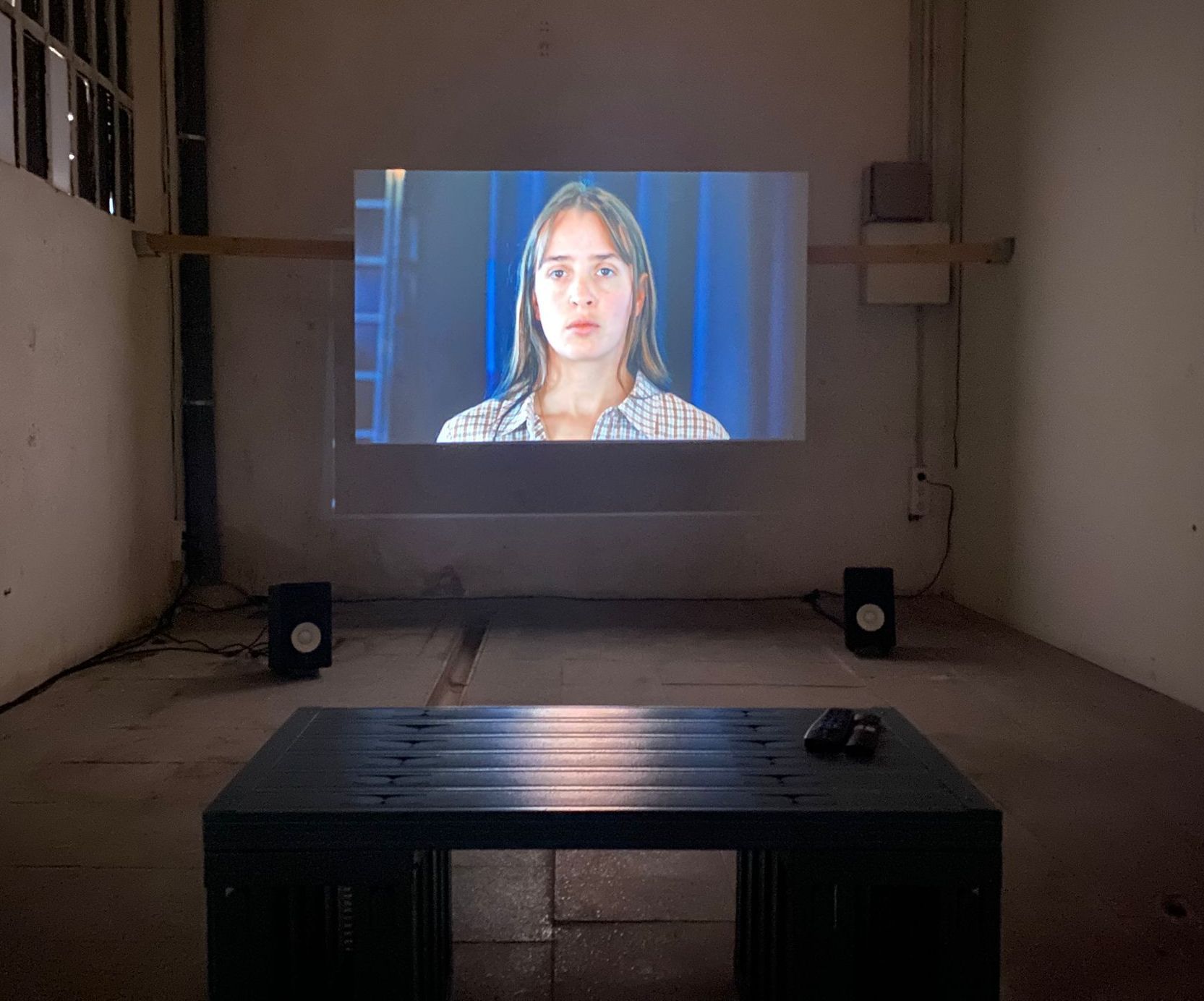
Instalation by Violeta Mayoral at etHALL

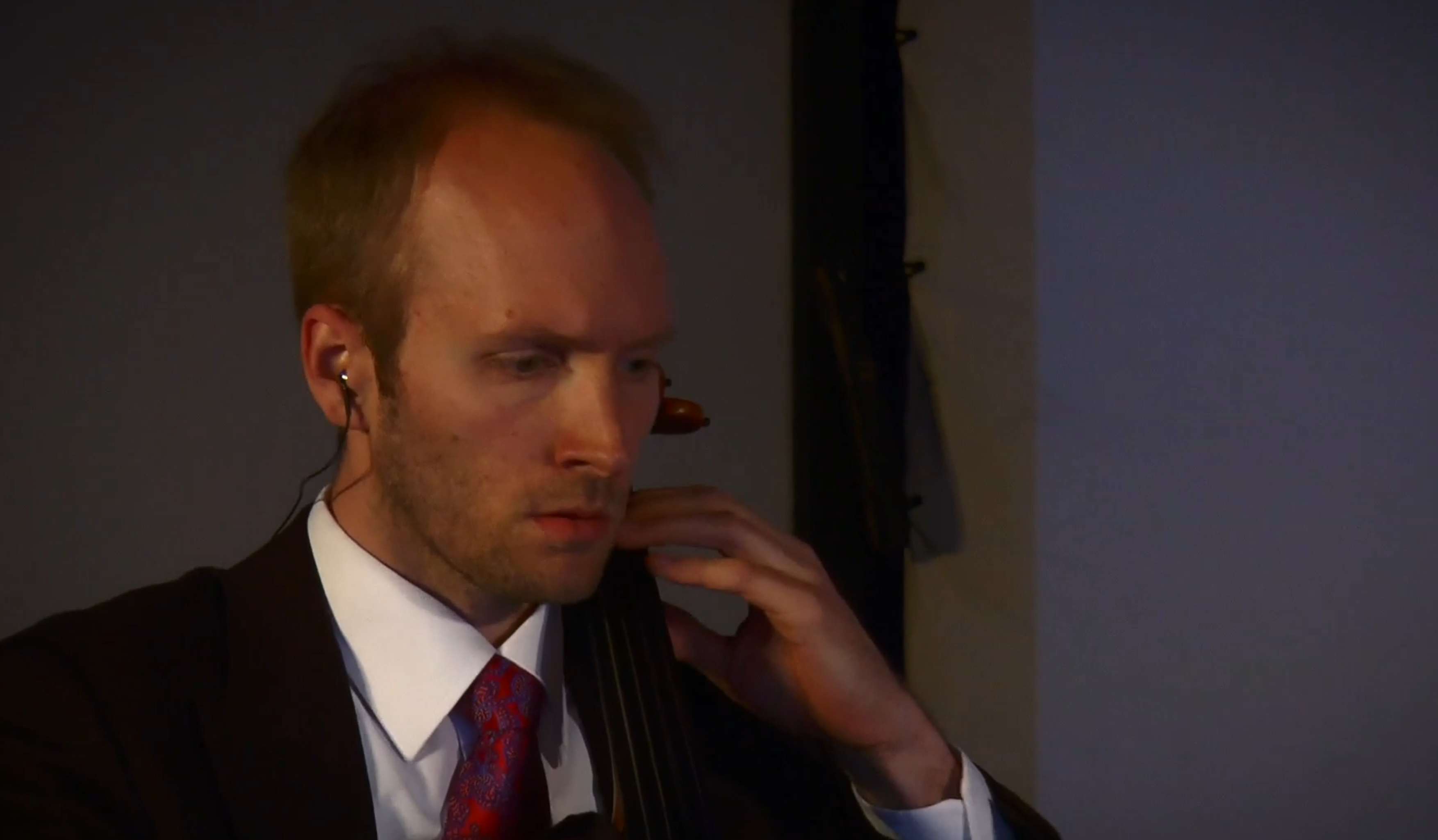
Anyone who belongs to the category determined by the title of this text knows that the video it refers to shows, in succession, the faces of four singers performing a piece of music in front of the camera, mentally, that is, without any sound coming from their throats or any music being heard. Each performance lasts about three minutes, the time it is understood to take to think the piece.

Although this title greatly reduces the chances of this text being disseminated—perhaps only relevant to its author and, to a lesser extent, to the author of the work in question—I am not going to restrict the scope of my speculations, which will cover a very broad area. If this work were exhibited in one of the international cultural hubs, if many people were to visit the exhibition regularly, if many of them stopped to watch the thirteen-minute video, if Violeta Mayoral’s work were studied extensively like that of Shakespeare or Velázquez, perhaps some of the viewers would remember, as I did while watching the work, a passage from Arthur Conan Doyle’s short story The Cardboard Box.

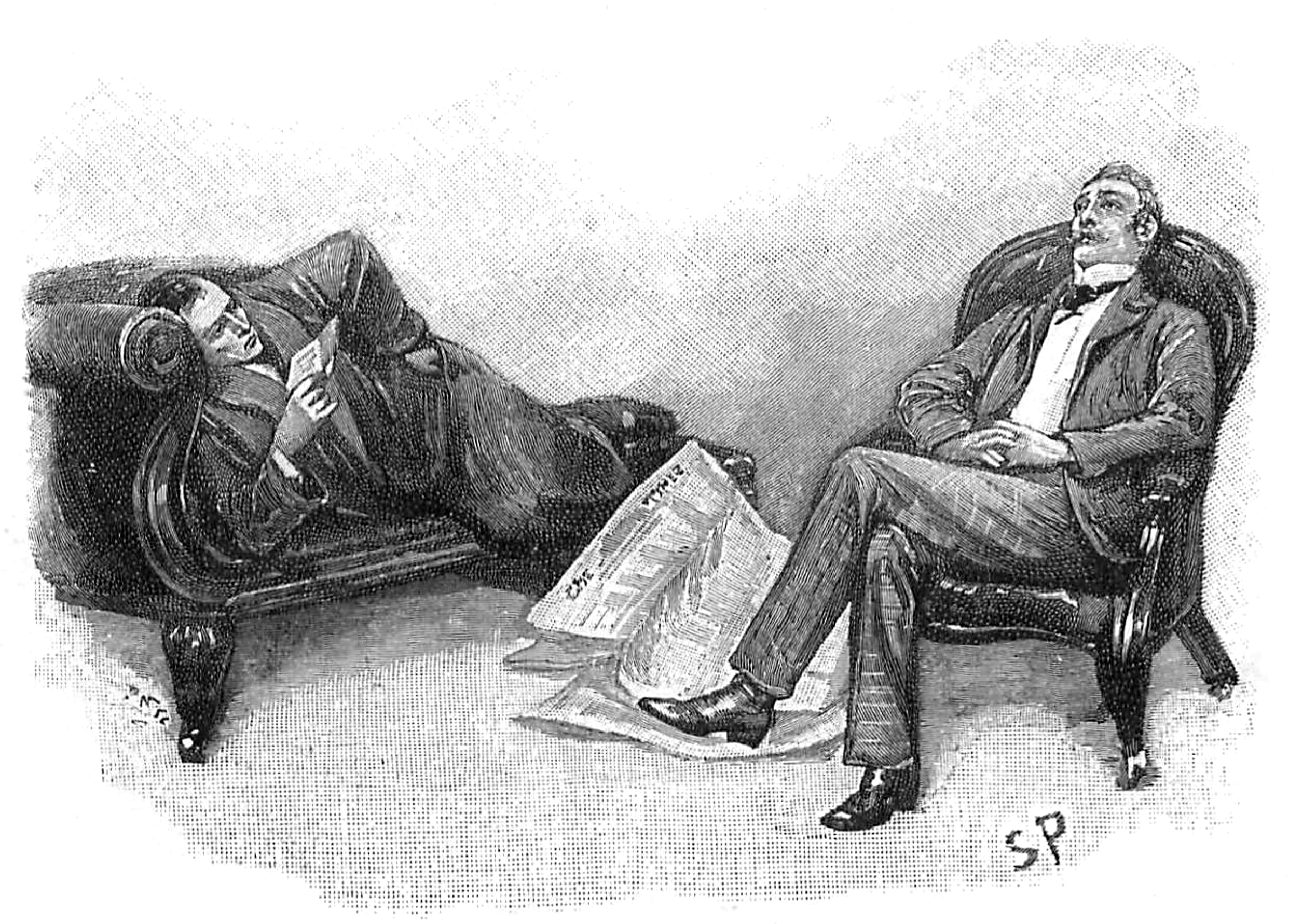
Illustration from The Strand Magazine, where The Cardboard Box was first published.

In it, Dr Watson, after giving up reading a newspaper and realising that Sherlock Holmes is too absorbed to talk, begins to think distractedly, until his companion interrupts him with an exclamation that seems out of context: «You are right, Watson,» said he.  «It does seem a most preposterous way of settling a dispute.».

- "Most preposterous!" I exclaimed, and then suddenly realizing how he had echoed the inmost thought of my soul, I sat up in my chair and stared at him in blank amazement. 
- "You remember," said he, "that some little time ago when I read you the passage in one of Poe's sketches in which a close reasoner follows the unspoken thoughts of his companion, you were inclined to treat the matter as a mere tour-de-force of the author.  On my remarking that I was constantly in the habit of doing the same thing you expressed incredulity. The features are given to man as the means by which he shall express his emotions, and yours are faithful servants."

From there, Holmes explains how he has been following the chain of Watson’s reasoning, starting with the gesture with the newspaper, by observing his appearance, his gestures, and especially his eyes, where he was looking, what facial expressions he was making, which part of his body he was touching, and so on, until he arrived at that final thought.

- “At this point I agreed with you that it was preposterous and was glad to find that all my deductions had been correct.”
- “Absolutely!" said I.  "And now that you have explained it, I confess that I am as amazed as before.”

If one were as perceptive and observant as Sherlock Holmes, one might be able to mentally hear the melody played in Mayoral’s video by simply examining the performers’ subtle —in most cases— facial movements. A first gesture could refer to a specific note, tone or melody, and from there all the others would be deduced —or abducted— in succession until the piece is finished, reproduced in the brain at the same rhythm as the performer. The performers’ faces are very expressive and, in fact, there are certain gestures that can be interpreted even by those who do not know much about music, gestures, or the interpretation of music or gestures: a general air of concentration and effort can be seen throughout all the performances.

Transactional psychologist Eric Berne conducted an experiment at the end of 1945 consisting of interviewing nearly 10,000 soldiers, who came to his office in succession over four months for about 50 seconds each, all dressed in the same military uniform and with the same haircut. He asked them two questions: ‘Are you nervous?’ and ‘Have you ever been to a psychiatrist?’ During this period, the author attempted to predict, based on silent observation of the soldier, how each man would answer the two routine questions in that particular situation. He saw that this could be done with surprising accuracy and wondered how he had managed to make those predictions, as they were not obvious.

The correct interpretation of gestures, both in Berne’s experiment and in the case of the video —or in Conan Doyle’s passage— requires repeated training in observation. You have to look closely at each gesture to understand its meaning. On one occasion, to create one of my works, Points of View (2008), I dubbed the voices of several artists, trying to synchronise my words with the movement of their lips, and I understood many of their expressions in a way that I would not have been able to without that detailed study of timing and intonation. Specifically, when dubbing the American artist Joan Jonas, I discovered that a pause in a sentence that I found unnatural to imitate, just before she mentions Goya’s name, responded to the artist’s modesty in comparing herself to that famous artist, an emotion that would have gone unnoticed in the usual viewing of the video.

It is certain that, even if the viewer does not possess this ability and is unfamiliar with the piece being performed – I do not know what melody was going through the minds of these singers – they can clearly perceive the start, that transition from calm to tension that marks the beginning, and then the feeling of relaxation that comes when it is supposed to end, followed by one of the performers leaving the frame and, in the other three cases, a neutral expression. In this sense, the relationship between the visitor and this work is somewhat similar to that between viewers and John Cage’s 4′33″. The beginning of that piece is marked by the opening of the piano lid and the end by the closing of the lid. What happens in between, according to many authors, is silence, and according to others, the accidental noises of the room. In the video, the gestures break a silence that, in the conceptual context of this work, would be equivalent to a completely hieratic attitude, one in which the mental exercise, in its purity, does not transcend the physical surface of the performers. The sound of their breathing, which can be heard occasionally, is in a different dimension.

With the exception of the first and last gestures, it can be said that all the others are inscrutable, indecipherable; they are ‘submerged’, one might say, and thanks to this metaphor I dare to compare the silenced melody with those submarines that left their bases in the Second World War and whose location could only be calculated by the enemy from their port of departure and with a strict measurement of time, imagining at each moment the corresponding point on the most probable route, a tentative record whose accuracy was not confirmed until the submarine surfaced again and was sighted. Whether the sequence is that of thought or melody, it will be the most logical thought and the most harmonious note that can give clues about the evolution of the piece.

All the problems presented by submarines in combat, or in films of the genre, are related to the interpretation of signs, the relationship between what the instruments, radar and sonar indicate and what is happening outside the vessel, or the image that the vessel projects to the outside world through bubble decoys and false or distorted messages intended to confuse those who are following it. A significant aspect of this work lies in this uncertainty: what lies behind those faces? What connection exists between those gestures and the music? It is a problem of translation, but above all of interface, of the mistrust that any interface invites when a critical viewer has deprived it of transparency. In other words, the work raises a question about technique and technology that is normally faced by technical figures such as doctors or detectives and, in some respects, also artists and philosophers. Almost all of the reflections I note here can refer to thinking about technology and interfaces.

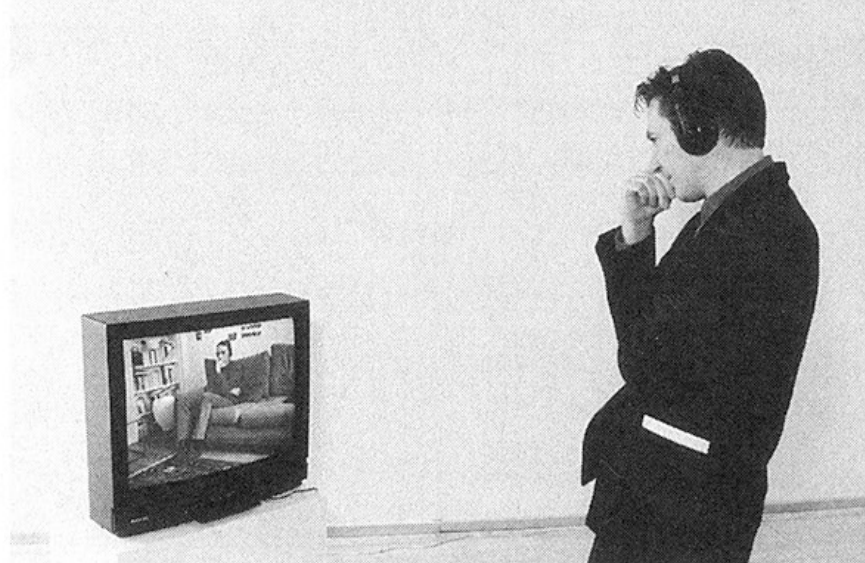
The Soldier’s Tale, Then and Now 1998, is approximately the same length as Mayoral’s workl

A work by Pierre Bismuth that I curated in 2005, in an exhibition on the psychological effect of works of art, presents a monitor showing a young man sitting in an armchair, concentrating on the music he is listening to through headphones. Next to the monitor is another armchair and another set of headphones. The viewer can sit down and listen to the music that the man was presumably listening to at the time of recording: Igor Stravinsky’s L’histoire du soldat. Although the man depicted in the images does not make any gestures, the feeling of intimacy with him experienced by the visitor who puts on the headphones is unsettling—as if they were sharing thoughts, reading each other’s minds through the music—even stranger when one realises that one is experiencing it in sync with the experience that man had in the past, when the video was recorded. In this case, many of the viewers are familiar with the melody, and it is also a musical melodrama, so to follow the sequence presented in the work, one can use either the rhythm of the music or the melody, the phrases or the complete story of the work, which is based on a Russian fairy tale. Bismuth’s work seems to propose a procedure for achieving this intimacy that is contrary to Mayoral’s, since here the gesture is null while the sound information is complete, even to the point of saturation.

Because in addition to training to interpret gestures, this synchronisation requires a certain disregard for logical processes, it requires a certain letting go, taking risks, a main component of Sherlock Holmes’ method of deduction, according to Thomas Sebeok and Jean Umiker-Sebeok in a book in which they compare the detective to Charles Sanders Peirce, the theorist of signs and father of contemporary semiotics (thanks to that book, I discovered that story by Conan Doyle). And so, in the strangeness of that intimacy, there is also a certain coercive effect: one feels a little forced to think that one’s mental processes are running in step with those of the young man, those of the music. And that same subordination occurs with the singers and their silent music, as if they and the spectators were all together in the same narrative, praying, united by the ceremonial repetition of a mantra (a mental instrument) used by religious sects to meditate, or to nullify individuality by synchronising the synaptic connections of all brains — or chanting the slogans established by propaganda at demonstrations. At the same time, it also brings to mind the sense of community that must have existed in oral societies prior to writing, where mythical stories, when spoken aloud, were reviewed over and over again in the minds of many who knew them or were learning them for the purpose of passing them on to their successors. When someone says “Con diez cañones por banda”, it is possible that the phrase “del uno al otro confín” will soon appear in the minds of many people of my generation (first and last verses of a popular stanza by Spanish poet José de Espronceda). I wonder if the experience of this video is similar for those who are perfectly familiar with the piece being performed—the artist and the protagonists, for example. The performers memorise the score and become the score themselves, as their gestures are the figures on the stave of the video, which the authorised viewer follows.

The game proposed is not recreational, but seductive. Mayoral’s work, while inviting this abandonment of one’s own judgement, this effort to alienate oneself in the personality of the performers and join their mental processes, prevents it through all the difficulties the video poses in identifying with them. Only if one feels captivated by the work, by the artist, or by art—as I am—can one maintain one’s interest in tension with these rejections. To be effective, the work demands an act of faith, you putting yourself in its hands and letting yourself be carried away. Suspecting that Bismuth’s character was actually listening to a different piece of music than the one being played does nothing to contribute to a more intense aesthetic experience. Viewers who consider their critical duty to assume that the singers are lying—that they are actually only pretending that a melody is running through their minds—or that the artist is doing so, will have a much poorer visit to the exhibition—to the extent of the poverty of that attitude. But that is not enough, and the complete experience also requires a constant awareness of what is happening, forcing one to maintain that tension. The game lies in the alternation between the suspension of disbelief and the Verfremdungseffekt.

Although I admit that the work has won me over, that does not mean that I like it completely. I find inconsistencies, some of which the artist may have already considered and decided were necessary, lesser evils—it may also be that her objectives were others that I cannot even imagine. It would take a great deal of effort to investigate what I would have done in her place, but it is certain that these rough edges help me to think, something that might not have been able to achieve a perfect work.

Because, in fact, one of the concerns that the work provoked in me was that, at times, the gestures seemed a little excessive. This is another way in which the work puts one in tune with the other viewers, as I imagine that we were all thinking at the same time at every moment of the film in the same sequence: “here he has exaggerated”, “that seems to have come from his guts”, “he is making a great effort”… and the video was the score for our thoughts.

At times, the singers’ expressiveness seemed unnatural, as if they felt obliged to assure the audience that they were, in fact, performing the piece, that they were not faking it. Watson’s attitude, as analysed by Holmes in the passage quoted above, is carefree; he does not know he is being observed, so it is understood that the connection between his thoughts and his gestures is mediated only by his personality, not by his conscious will. The performers, on the other hand, whether they like it or not, feel observed, and this affects their behaviour, especially when what is asked of them disregards the ability that gives them confidence on stage: they have been told not to make any sound and, probably, also to avoid making a fuss – I wondered there, too, if they should perform only mentally or if they were allowed to do so respiratorily. But overacting seems natural when you have been deprived of the resource of that voice through which all the expressiveness of singing is usually channelled, and which, once repressed, is forced to come out elsewhere, like water that is prevented from escaping and ends up finding a crack through which to gush forth. In some works of art involving actors, the artist achieves naturalness through saturation, forcing the performer to pay attention to so many complex tasks that they have no mind for anything else. There are many contemporary examples, but for proximity’s sake, I will cite Erik Bünger’s work The Empire Never Ended, in which a musician is forced to perform a composition so fast and complex that it demands more concentration than is possible, and in this way ‘operates at the intersection where total control and total lack of control coincide’ – note the musician’s face of absolute alienation. It is a phenomenon that I experienced personally during my short period of learning the Japanese tea ceremony, and continuously throughout my artistic practice, when I set such ambitious goals for my projects that they require my total effort, overwhelm me and, as a result, can only disappoint.

The Empire Never Ended, Erik Bünger

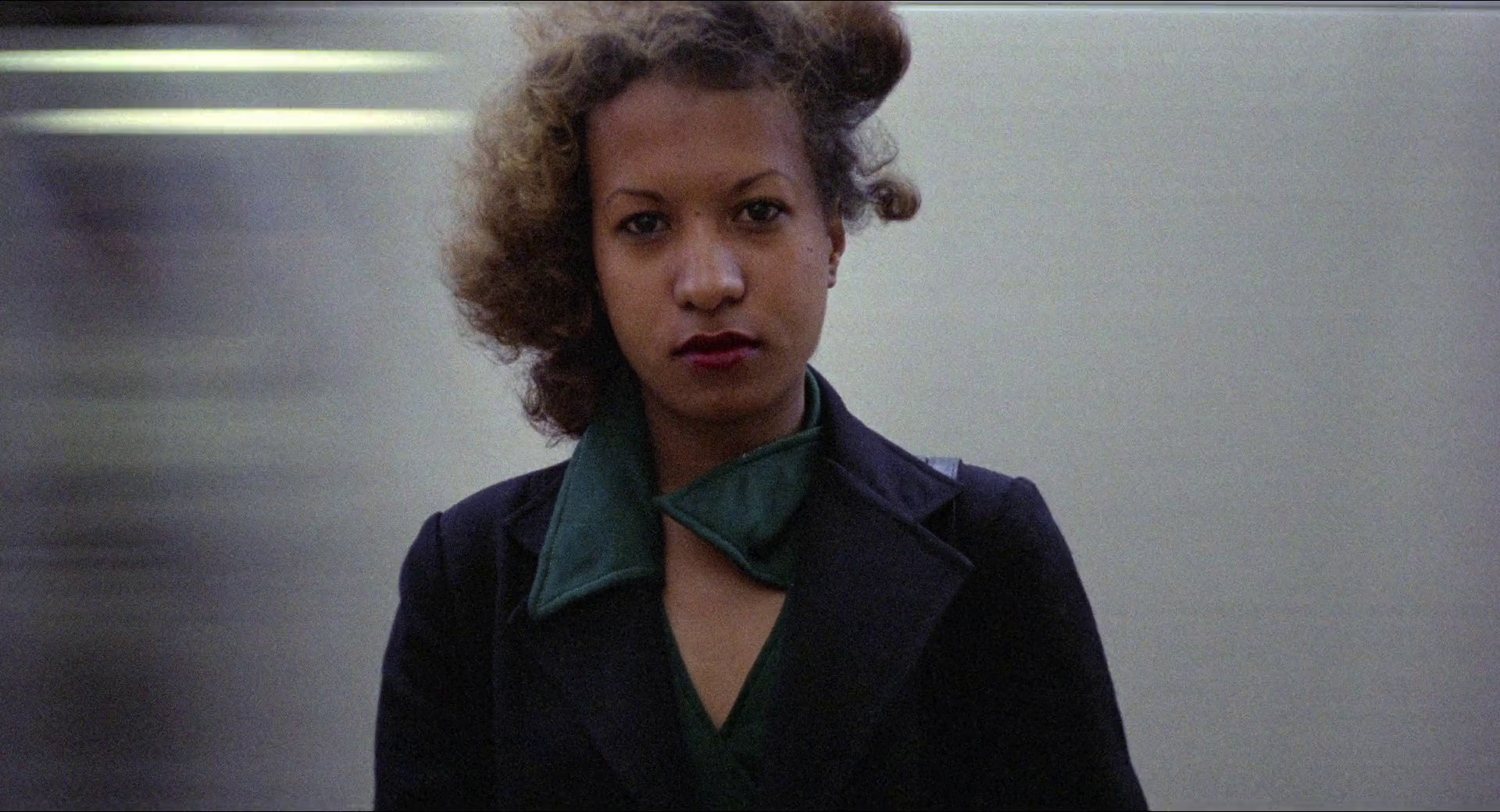
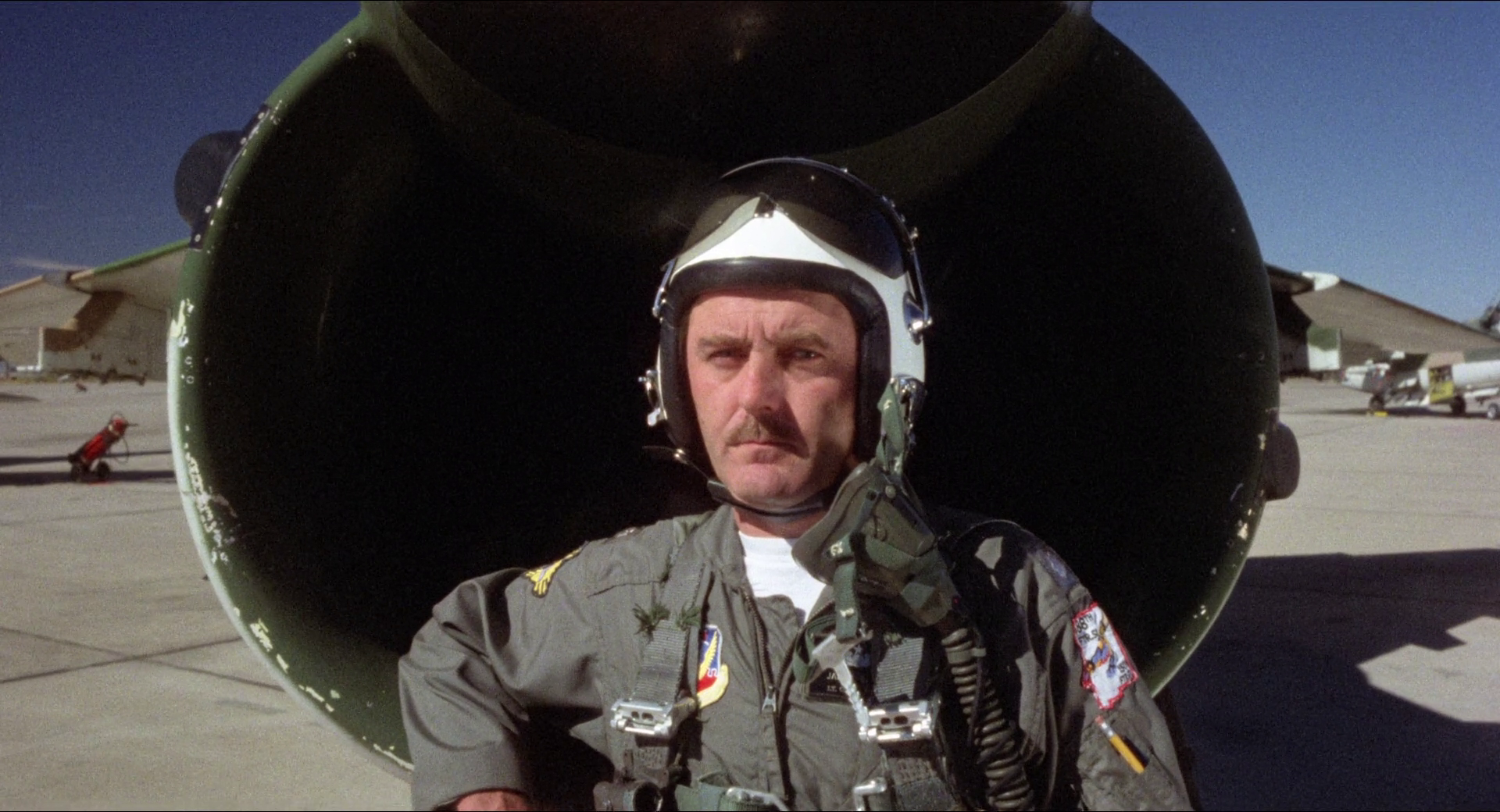
Another doubt that the work raises for me concerns formal decisions. During the screening, I was distracted several times by wondering whether the protagonists were reading a score on a teleprompter, as they were staring intently at the camera. As I later learned, these mental singers perform from memory. Reading the score would have seemed natural in the musical medium, as well as enhancing their credibility and better synchronising the minds of the performers and the viewer, as if they were singing karaoke, united in the rhythm marked by the notation. I cannot think of anything that makes the video more interesting by the fact that they stare at the viewer, except that in this way the work adheres to a convention that makes it seem like contemporary art, creating another kind of intimacy with the audience, as happens, for example, with the portraits in Koyaanisqatsi, with Rineke Dijkstra’s photographed characters, or in Gillian Wearing’s work 60 Minutes Silence.

Two stills from Godfrey Reggio’s Koyaanisqatsi (1982)

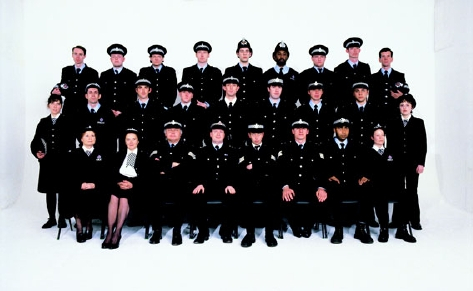
In this latter work, the artist presents on a video a group of uniformed police officers who stare silently and motionlessly at the camera for one minute (the description of Wearing’s work in the Arts Council collection literally states that ‘none of the characters or individuals speaks their mind here’). It could be a real military band mentally performing a piece of music, and we would perceive by simply Wearing telling us so, if we decided to have faith in her or in art, as I have said seems appropriate in every artistic occasion, even though in this case, those portrayed are not even police officers, but actors dressed as police officers. If this circumstance has any significance, it is only in the same direction but in the opposite sense to that which Roberto Rossellini gave to the fact that in his 1954 film Francesco, giullare di Dio, the roles of the monks of the group of St. Francis of Assisi were played by real Franciscan monks.

60 Minutes Silence by Gillian Wearing.

The gaze towards the camera contributes to the effect that puzzled me, whereby the performers in the play seem more aware of the instrument and the presence of the audience, which enhanced the feeling of artificiality. The direct gaze conveys a sense of special awareness, as Roland Barthes, our trusted semiotician, points out in an appendix to his book L’obvie et l’obtus, 1982.

In the Rijksmuseum in Amsterdam, there is a series of paintings by an anonymous painter known as “The Master of Alkmaar”. They are scenes from everyday life, with people gathered for one reason or another, which changes in each painting; in each of the groups there is a character, always the same: lost in the crowd, while the others appear unaware, this is the only one who, in each painting, looks the painter (and me too) straight in the eye. This character is Christ.

For this reason, I believe that it would have been more appropriate to the meaning of the work, richer, if the singers had been presented, as far as possible, lost in their thoughts – like Watson or, in another sense, Holmes when concentrating on his object of study.

Finally, one last cause for concern for me is the feeling that many of the artist’s decisions are inconsistent. I do not mean to say that there are other necessary ones, but that the ones that have been chosen, even if they are the best, do not manage to free me from that feeling of inconsistency. In a way, every work of art is unfounded—every poem—and in honour of accuracy, it would be better if it did not exist, but many of them manage to create the fiction of a complete closure in their process. The choice of the musical piece, its duration, the number of performers, their sequential rather than simultaneous appearance, or the size of the projection, which makes the figures larger than life… are not justified in themselves, nor by each other. I have also always wondered what reason there was for Cage’s work to last four minutes and thirty-three seconds, apart from purely promotional reasons and Cage’s frequent glorification of arbitrariness, which I particularly dislike.

Despite these objections, it is clear that the experience of viewing this work, as with most of the few works of art I encounter, is particularly satisfying because of the artist’s willingness to make you feel intelligent. More and more often, one is treated as if one were stupid, because that is what most of the population demands, and so that is what it is given. During the screening, and in the days since, when the memory of it has circulated in my mind, I have felt like that detective who can understand the most complex riddles—although here, perhaps, the difficulty and the value lie precisely in the simplicity of the riddle. Ludwig Wittgenstein and W. H. Auden, two of my heroes—to call them ‘favourite authors’ would be a lack of decorum and an emotional betrayal—were particularly fond of detective novels, and I have no trouble explaining why, nor identifying with that fondness. Art and philosophy are that search for clues, which cannot be tackled using the usual mathematical logic employed by scientists (‘cette saloperie de logique’, as Becket would say), but rather through what Peirce calls ‘logic utens’, which is a certain general method by which each person arrives at the truth, without, however, being aware of that method and without being able to specify what it consists of. Therein lies one reason why Wittgenstein became fond of crime fiction: the minimalism of the genre often represents an essential aspect of his philosophy. This style of literature has the ability to say without really saying, to use indirect means such as tone and mood, atmosphere and setting, symbolism and the choice of details to evoke an understanding, or simply a feeling, that is all the stronger, and perhaps all the truer, for never having been explicitly expressed.

Dupin, Poe’s close reasoner referred to by Holmes above, in The Purloined Letter, meets with the police prefect, a diligent but unimaginative investigator who fails to locate the letter of the title because he relies on conventional, ‘mathematical’ methods of investigation. He assumes that the thief must have concealed the letter in a complex, hidden or secret compartment. In reality, as Dupin easily discovers, it is hidden in plain sight. And that is another difference between the pursuit of art and that of science, because in art everything is clear and simple and visible at first glance, and one only needs to look carefully. In fact, Holmes often insists to Watson that he sees the same things as other people, and that he has simply trained himself to apply his method in order to determine the full meaning of those perceptions. ‘Watson, you see everything. However, you fail to reason about what you see. You are too timid in making your inferences.’ It takes courage, in the execution or contemplation of a work, to understand that the problem has already been posed, rather than giving up at first glance. Wittgenstein believed that philosophical problems are not solved by finding new hidden facts, but by organising the known facts that are already in view. As Watson says at the end of that story, everything is explained, and yet it remains amazing. The wonder of art is that the trick is not really a trick: the artist—the poet, the philosopher—is a detective who never finds the murderer. But he is very good at his job and manages to find everything else.

I must quote Auden to conclude this reflection, as he wrote that in reading, ‘the identification of fantasy is always an attempt to avoid one’s own suffering: the identification of art is a sharing in the suffering of another.’ That is the kind of identification I have found in the work that has prompted me to write all this.

For Your Eyes Only

(Para quienes, al ver la obra de Violeta Mayoral, se han puesto a pensar, distraídamente, en su significado)

Instalación de Violeta Mayoral en etHALL

Quien pertenezca a la categoría que determina el título de este texto sabe que el video al que se refiere muestra en sucesión la cara de cuatro cantantes, que interpretan una pieza musical frente a la cámara, mentalmente, es decir, sin que salga sonido de sus gargantas ni se oiga música alguna. Cada interpretación dura unos tres minutos, el tiempo que se entiende que requiere pensar la pieza.

Por más que ese título reduzca mucho las posibilidades de difusión de este escrito -quizá solo competa a su autor y, en su justa medida, a la autora de la obra referida-, sin embargo no por ello voy a restringir el alcance de mis especulaciones, que cubrirán un área muy extensa. Si esta obra estuviera expuesta en uno de los hubs internacionales de la cultura, si mucha gente visitara constantemente la exposición, si muchos de ellos se detuvieran a observarla los trece minutos que dura el video, si la obra de Violeta Mayoral fuera estudiada profusamente como la de Shakespeare o la de Velázquez, quizá alguno de entre todos los espectadores recordaría, como yo mientras veía la obra, un pasaje del cuento corto de Arthur Conan Doyle La caja de cartón.

Ilustración de la revista The Strand Magazine, donde se publicó por primera vez La caja de cartón.

En él, el doctor Watson, tras abandonar la lectura de un periódico y comprobar que Sherlock Holmes está demasiado abstraído como para conversar, se pone a pensar distraídamente, hasta el momento en el que su compañero le interrumpe con una exclamación que parece fuera de contexto: «Está en lo cierto, Watson, me parece una manera muy absurda de saldar una disputa».

- ¡De lo más absurda!- exclamé, y de pronto, comprendiendo que Holmes se había hecho eco del pensamiento más íntimo de mi alma, me incorporé del sillón y le miré perplejo.
- Recuerde usted que hace algún tiempo, cuando le leí el pasaje de uno de los relatos de Poe en el que un minucioso razonador sigue los pensamientos no expresados de su compañero, usted se sintió inclinado a tratar el asunto como un mero tour de force del autor. Al advertirle que yo solía hacer eso constantemente, usted se mostró incrédulo. Las apariencias del hombre expresan sus emociones y las suyas son sirvientes fieles.

A partir de ahí, Holmes explica cómo ha ido siguiendo el curso de los razonamientos encadenados de Watson, a partir del gesto del periódico, mediante la observación de su aspecto, sus muecas y, especialmente, sus ojos, hacia dónde miraba, qué muecas hacía, la parte del cuerpo que se tocaba, etcétera, hasta llegar a ese último pensamiento.

- En este momento asentí con usted y le dije que eso era absurdo, y me alegré al darme cuenta de que todas mis deducciones eran correctas.
- ¡Totalmente correctas! Y ahora que usted lo ha explicado todo, confieso que estoy tan maravillado como al principio.

Si uno fuera tan perspicaz y observador como Sherlock Holmes, quizá podría escuchar mentalmente la melodía que se interpreta en el video de Mayoral, mediante tan solo el examen de los, en la mayor parte de los casos, sutiles movimientos faciales de los intérpretes. Un primer gesto podría referirse a una nota concreta, un tono o melodía, y a partir de ahí todos los demás serían deducidos -o abducidos- en sucesión hasta acabar la pieza, reproducidos en el cerebro, al mismo ritmo que el intérprete. Las caras de los ejecutantes son muy expresivas y en efecto hay ciertos gestos interpretables incluso para quien no sabe mucho de músicas ni de gestos, ni de interpretaciones de músicas o de gestos: un aire general de concentración y de esfuerzo se aprecia a lo largo de todas las ejecuciones.

El psicólogo transaccional Eric Berne realizó un experimento a final del año 1945 consistente en entrevistar a cerca de 10.000 soldados, que pasaron por su consulta en sucesión durante cuatro meses por alrededor de 50 segundos cada uno, todos vestidos con la misma ropa militar, el mismo corte de pelo. Les hizo dos preguntas: «¿Está Ud. nervioso?» y «¿Alguna vez ha ido a un psiquiatra?». Durante este período el autor hizo un intento de predecir, a partir de la observación silenciosa del soldado, cómo respondería cada hombre las dos preguntas rutinarias en esa situación particular. Vio que esto podía hacerse con sorprendente exactitud y se preguntó cómo había logrado hacer esas predicciones, ya que no eran evidentes.

La interpretación correcta de los gestos, tanto en el experimento de Berne como en el caso del video -o en el pasaje de Conan Doyle- requiere un entrenamiento repetido en la observación. Hay que mirar con detenimiento cada gesto, para reparar en su significado. En una ocasión, para realizar una obra, Points of View (2008), doblé la voz de varios artistas intentando sincronizar mis palabras con el movimiento de sus labios y entendí muchas de sus expresiones de una forma que no hubiera podido sin ese estudio pormenorizado de tiempos y entonaciones. En concreto, al doblar a la artista americana Joan Jonas descubrí que una pausa en una frase que no me resultaba natural imitar, justo antes de citar el nombre de Goya, respondía al pudor que sentía la artista al compararse con ese artista famoso, una emoción que en el visionado habitual del video me hubiera pasado desapercibida.

Es seguro que, aunque el espectador no posea esa habilidad y no conozca la pieza que se interpreta -no sé qué melodía pasaba por las mentes de estos cantantes-, puede percibir claramente el arranque, ese paso de la calma a la tensión que marca el inicio, y después, la sensación de relax que llega cuando se supone que termina, y a la que sigue la salida de plano de uno de los intérpretes y, en los otros tres casos, una expresión neutra. En ese sentido, la relación entre el visitante y esta obra se parece un poco a la que los espectadores mantienen con 4′33″ de John Cage. El principio de esa pieza está marcado por la apertura de la tapa del piano y el final por el cierre de la tapa. Lo que sucede entre medias, según muchos autores, es el silencio, y según otros, los ruidos accidentales de la sala. En el video, los gestos rompen un silencio que, en el contexto conceptual de esta obra, equivaldría a una actitud completamente hierática, una en la que el ejercicio mental, en su pureza, no traspasase a la superficie física de los ejecutantes. El sonido de sus respiraciones, que se puede escuchar ocasionalmente, se encuentra en otra dimensión distinta.

A excepción del primero y del último gesto, se puede decir que todos los demás son inescrutables, indescifrables; están «sumergidos», se podría decir, y gracias a esta metáfora me atrevo a comparar la melodía silenciada con aquellos submarinos que abandonaban sus bases en la segunda guerra mundial y de los que el enemigo solo podía calcular la localización a partir de su puerto de salida y con una medición estricta del tiempo, imaginando en cada momento el punto correspondiente en la ruta más probable, una registro tentativo cuya exactitud no se confirmaba hasta que el submarino emergía de nuevo y era avistado. Si la secuencia es la del pensamiento o la de la melodía, serán el pensamiento más lógico y la nota más armónica, los que pueden dar pistas sobre la evolución de la pieza.

Todos los problemas que presentan los submarinos en combate, o en las películas del género, son de interpretación de signos, de la relación de lo que indican los instrumentos, el radar, el sonar, con lo que sucede en el exterior del buque, o bien de la imagen que el buque proyecta al exterior, mediante señuelos burbujas, y mensajes falsos o distorsionados, destinados a confundir a quienes le siguen. Y un aspecto significativo de esta obra se encuentra en esa incertidumbre:¿qué hay detrás de esas caras? ¿qué conexión existe entre esos gestos y la música? Un problema de traducción, pero sobre todo de interfaz, de la desconfianza a la que invita cualquier interfaz al que un espectador crítico ha privado de transparencia. Es decir, la obra presenta un interrogante sobre la técnica y la tecnología al que normalmente se enfrentan figuras técnicas como son los médicos o los detectives y, en algunos aspectos, también los artistas y los filósofos. Casi todas las reflexiones que apunto aquí pueden referirse al pensamiento de la tecnología y el interfaz.

The Soldier’s Tale, Then and Now 1998, tiene la misma duración, aproximadamente, que la obra de Mayoral

Una obra de Pierre Bismuth que comisarié en 2005 en una exposición sobre el efecto psicológico de las obras de arte, presenta un monitor en el que se ve a un hombre joven sentado en un sillón, concentrado en la música que escucha a través de auriculares. Junto al monitor hay otro sillón y otros auriculares. El espectador puede sentarse y seguir la música que se supone escuchaba el hombre en el momento de la grabación: L’histoire de soldat, de Igor Stravinsky. A pesar de que el hombre representado en las imágenes no hace ningún gesto, la sensación de intimidad con él que experimenta el visitante que se pone los auriculares es inquietante -como si compartieran los pensamientos, y se leyeran uno a otra la mente mediante la música-, más extraña si cabe cuando se sabe que uno la está viviendo en sincronía con la experiencia que ese hombre tuvo en el pasado, cuando se grabó el video. En este caso, muchos de los espectadores conocen la melodía y se trata, además, de un melodrama musical, y para seguir la secuencia que presenta la obra uno puede servirse tanto del ritmo de la música como de la melodía, las frases o la historia completa de la obra, que está basada en un cuento ruso. La obra de Bismuth parece proponer un procedimiento para conseguir esa intimidad contrario al de la de Mayoral, ya que aquí el gesto es nulo mientras que la información sonora es completa, incluso hasta el grado de saturación.

Porque además de entrenamiento para interpretar los gestos, esta sincronización requiere un cierto desprecio por los procesos lógicos, requiere un cierto dejarse llevar, arriesgarse, un componente principal del método de deducción de Sherlock Holmes, según afirman Thomas Sebeok and Jean Umiker-Sebeok en un libro en el que comparan al detective con Charles Sanders Peirce, el teórico de los signos y padre de la semiótica contemporánea (gracias a ese libro conocí ese cuento de Conan Doyle). Y así, en la extrañeza de esa intimidad participa también un cierto efecto de coerción: uno se siente un poco forzado a pensar que sus procesos mentales corren al compás de los del joven, de los de la música. Y esa misma subordinación se da con los cantantes y su música silenciosa, como si estuvieran ellos, y los espectadores, todos unidos en una misma narración, orando, hermanados por la repetición ceremonial de un mantra (instrumento mental) de los que usan las sectas religiosas para meditar, o para anular la individualidad al acompasar las conexiones sinápticas de todos los cerebros -o coreando en las manifestaciones las consignas establecidas por la propaganda-. Por otro lado, también hace pensar en el sentimiento de comunidad que debió existir en las sociedades orales anteriores a la escritura, en las que los relatos míticos, al pronunciarse en voz alta, se repasaban al mismo tiempo una y otra vez en las mentes de muchos que los conocían o estaban aprendiéndolos con el propósito de trasmitirlos a sus sucesores. Cuando alguien dice «Con cien cañones por banda», es posible que en la mente de muchas personas de mi generación aparezca poco después la fórmula «del uno al otro confín». Me pregunto si la experiencia de este video es parecida para quien conoce perfectamente la pieza interpretada —la artista y los protagonistas, por ejemplo—. Los intérpretes memorizan la partitura, y se convierten en partitura ellos mismos, ya que sus gestos son las figuras sobre el pentagrama del video, que sigue el espectador autorizado.

El juego que se propone no es recreativo, sino de seducción. La obra de Mayoral, a la vez que invita a esta dejación del juicio propio, a este esfuerzo por alienarse en la personalidad de los ejecutantes y unirse a sus procesos mentales, la impide mediante todas esas dificultades que pone el video para identificarse con los intérpretes. Solo si uno se siente captado por la obra, por la artista, o por el arte —como yo lo estoy— puede mantener la atención en tensión con esos rechazos. Para ser efectiva, la obra reclama hacer un acto de fe, que te pongas en sus manos y te dejes llevar. El sospechar que el personaje de Bismuth en realidad escuchaba otra pieza musical distinta que la reproducida no contribuye en nada a una experiencia estética más intensa. El espectador que considere su deber crítico el presumir que los cantantes mienten —que en realidad solo están haciendo como que una melodía pasa por sus mentes—, o que lo hace la artista, tendrá una visita a la exposición mucho más pobre —en el grado de la pobreza de esa actitud—. Pero eso no es suficiente, y la experiencia completa también exige una consciencia constante de lo que sucede, obliga a mantener esa tensión. El juego se encuentra en la alternancia entre la suspensión de la incredulidad y el Verfremdungseffekt.

A pesar de admitir que la obra me ha conquistado, eso no implica que me guste por completo. Encuentro inconsistencias, algunas que quizá la artista ya consideró y decidió que eran necesarias, males menores -también puede ser que sus objetivos fueran otros que no alcanzo ni a imaginar-. Requeriría una gran disposición investigar qué hubiera hecho yo en su lugar, pero es seguro que esas asperezas me ayudan a pensar como quizá no hubiera podido hacer una obra perfecta.

Porque, en efecto, una inquietud de las varias que me provocó la obra se debe a que, en ocasiones, los gestos me parecieron un tanto excesivos. Ese es otro modo por el que la obra le pone a uno en sintonía con los demás espectadores, al imaginarme que pensábamos todos a la vez en cada momento de la cinta en la misma secuencia «aquí ha exagerado», «eso parece haberle salido del alma», «le está costando gran esfuerzo»…, y el video fuera esa partitura para nuestros pensamientos.

Por momentos la expresividad de los cantantes denotaba falta de naturalidad, como si se sintieran obligados a asegurar al espectador que estaban, efectivamente, interpretando la pieza, que no engañaban. La actitud de Watson analizada por Holmes en ese pasaje citado es despreocupada, no sabe que es observado, por lo que se entiende que la conexión entre su pensamiento y sus gestos solo está mediada por su personalidad, no por su voluntad consciente. Los intérpretes, por el contrario, lo quieran o no, se sienten observados, y eso afecta a su comportamiento, especialmente cuando lo que se les pide desprecia esa habilidad que les confiere seguridad en escena: se les ha dicho que no emitan sonido alguno y, probablemente, también que eviten grandes aspavientos —me pregunté allí, además, si debían interpretar solo mentalmente o tenían permitido hacerlo respiratoriamente—. Pero sobreactuar parece natural cuando te han privado del recurso de esa voz por el que habitualmente se canaliza toda esa expresividad del canto, y que, una vez reprimida, se ve obligada a salir por otro lado como agua a la que se le impide la fuga y acaba por encontrar una grieta en la que convertirse en surtidor. En algunas obras de arte en las que participan actores, el artista consigue la naturalidad mediante la saturación, obligando al ejecutante a prestar atención a tantas tareas y tan complejas que no le quede mente para otra cosa. Hay muchos ejemplos contemporáneos pero, por proximidad, citaré la obra de Erik Bünger The Empire Never Ended, en la que un músico se ve obligado a interpretar una composición tan rápida y compleja que exige más concentración de la posible y de esa manera «opera en la intersección donde coinciden el control total y la falta total de control» -obsérvese la cara de absoluto enajenamiento del músico-. Es un fenómeno que experimenté personalmente en mi corto período de aprendizaje de la ceremonia del té japonesa, y continuamente en toda mi práctica artística, cuando marco objetivos tan ambiciosos para mis proyectos que requieren la totalidad de mi esfuerzo, que me superan y cuyo resultado, por tanto, no puede sino defraudar.

The Empire Never Ended, Erik Bünger

Otra duda que me crea la obra se refiere a decisiones formales. Durante la proyección me distraje varias veces al preguntarme si los protagonistas leían una partitura en un teleprompter, ya que tenían la mirada fija y atenta en la cámara. Según pude saber después, estos cantantes mentales interpretan de memoria. Leer la partitura hubiera parecido natural en el medio musical además de favorecer su credibilidad y de sincronizar mejor las mentes de los intérpretes y del espectador, como si cantaran un karaoke, unidos en el ritmo que marca el paso de las notaciones. No puedo pensar en nada que haga el video más interesante por el hecho de que miren fijamente al espectador excepto en cuanto a que así la obra se adhiere a una convención que la hace parecer arte contemporáneo, al crear otra intimidad distinta con el público como sucede, por ejemplo, con los retratos de Koyaanisqatsi, con los personajes fotografiados de Rineke Dijkstra, o en la obra 60 Minutes Silence de Gillian Wearing.

Dos fotogramas de Koyaanisqatsi (1982) de Godfrey Reggio

En esta última obra, en video, presenta a un grupo de policías uniformados que miran a la cámara silenciosos e inmóviles durante un minuto (La descripción de la obra de Wearing en la colección de Arts Council dice, literalmente, que «none of the characters or individuals speaks their mind here»). Podría tratarse de una auténtica banda musical militar que está interpretando mentalmente una pieza musical, y eso percibiríamos tan solo con que Wearing nos lo dijera, si decidiéramos tener fe en ella o en el arte, como he dicho que parece conveniente en cada ocasión artística, por más que en este caso, los retratados ni siquiera sean policías, sino actores disfrazados de policía. Si esta circunstancia tiene alguna importancia, es sólo en la misma dirección pero en sentido contrario que la que Roberto Rossellini concedió al hecho de que en su película de 1954 Francesco, giullare di Dio, los papeles de los monjes del grupo de San Francisco de Asís estuvieran interpretados por auténticos monjes franciscanos.

60 Minutes Silence de Gillian Wearing.

La mirada hacia la cámara contribuye a ese efecto que me desconcertaba por el que los intérpretes de la obra parecen más conscientes del instrumento y de la presencia del público y que favorecía la sensación de artificialidad. La mirada directa transmite una sensación de especial consciencia, como destaca Roland Barthes, nuestro semiótico de confianza, en un anexo de su libro Lo obvio y lo obtuso.

En el Rijksmuseum de Amsterdam hay una serie de cuadros de un pintor anónimo al que se conoce como «El Maestro de Alkmaar». Son escenas de la vida cotidiana, las gentes se aglomeran por una u otra razón, que cambia en cada cuadro; en cada uno de los grupos hay un personaje, siempre el mismo: perdido en la muchedumbre, mientras que unos y otros aparecen representados como sin enterarse, éste es el único que, en cada cuadro, mira al pintor (y a mí también) directo a los ojos. Este personaje es Cristo.

Por este motivo creo que hubiera encontrado más ajustado al sentido de la obra, más rico, el que los cantantes hubieran sido presentados, en la medida de lo posible, abstraídos en sus pensamientos —como Watson o, en otro sentido, Holmes al concentrarse en su objeto de estudio—.

Finalmente, un último motivo de preocupación para mí es la sensación de que muchas de las decisiones de la artista son inconsistentes. No quiero decir con esto que existan otras necesarias, sino que las que se han elegido, por más que sean las mejores, no consiguen librarme de esa sensación de inconsistencia. En cierto modo toda obra de arte es infundada —todo poema—, y en honor a la exactitud sería mejor que no existiera, pero muchas de ellas consiguen crear en su proceso la ficción de un cierre completo. La elección de la pieza musical, de la duración, del número de intérpretes, de su aparición secuencial en lugar de simultánea, o del tamaño de la proyección, que hace sus figuras mayores del tamaño real… no se justifican en sí mismas, ni unas por las otras. También me he preguntado siempre qué razón existía para que la obra de Cage durara cuatro minutos treinta y tres segundos, a parte de los puramente promocionales, y de esa glorificación de la arbitrariedad que hace Cage a menudo y que a mí particularmente me disgusta.

A pesar de estas objeciones, es claro que la experiencia de contemplar esta obra, como en la mayoría de las pocas obras de arte con las que me encuentro, resulta especialmente satisfactoria por la disposición de la artista a hacerte sentir inteligente. Cada vez uno es tratado más a menudo como si fuera tonto, porque es lo que reclama la mayor parte de la población y entonces es lo que le suministra. Durante la proyección, y en los días después en los que su recuerdo ha circulado por mi mente, me he sentido como ese detective que puede comprender los acertijos más complejos -aunque aquí, quizá, la dificultad y el valor se encuentren, precisamente, en la simpleza del acertijo-. Ludwig Wittgenstein y W. H. Auden, dos de mis héroes —llamarlos “autores favoritos” sería una falta de decoro y una traición afectiva—, eran especialmente aficionados a las novelas de detectives y no me cuesta explicarme por qué, ni identificarme con esa afición. El arte y la filosofía son esa búsqueda de claves, que no puede ser enfrentada mediante la lógica matemática habitual que usan los científicos (cette saloperie de logique, que diría Becket), sino mediante lo que Peirce llama «lógica utens», que es un cierto método general por el que cada uno llega a la verdad, sin, no obstante, ser consciente de ello y sin poder especificar en qué consiste ese método. Ahí se puede encontrar una razón por la que Wittgenstein se aficionó a la literatura negra: el minimalismo del género a menudo representa un aspecto esencial de su filosofía. Ese estilo de literatura tiene la habilidad de decir sin decir realmente, de utilizar medios indirectos como el tono y el estado de ánimo, la atmósfera y la escena, el simbolismo y la elección de los detalles para evocar una comprensión, o simplemente un sentimiento, que es tanto más fuerte, y quizás tanto más verdadero, por no haberse expresado nunca de forma explícita.

Dupin, el minucioso razonador de Poe al que se refería Holmes más arriba, en La carta robada, se encuentra con el prefecto de policía, un investigador diligente pero poco imaginativo que no logra localizar esa carta del título porque se basa en métodos de investigación convencionales y «matemáticos». Asume que el ladrón debe haber escondido la carta en un compartimento complejo, oculto o secreto. En realidad, como fácilmente descubre Dupin, se encuentra oculta a plena vista. Y esa es otra diferencia entre la búsqueda del arte y la de la ciencia, porque en arte todo es claro y sencillo y está a la vista de primeras, y solo hace falta mirar con atención. De hecho, Holmes le insiste a menudo a Watson que ve lo mismo que las otras personas, y que tan solo se ha entrenado para aplicar su método a fin de determinar el significado total de esas percepciones. «Watson, usted lo ve todo. Le falta, sin embargo, razonar sobre lo que ve. Es demasiado tímido al hacer sus inferencias.» Hace falta arrojo, en la ejecución o contemplación de una obra, para entender que el problema ya está planteado en lugar de darse de primeras por vencido. Wittgenstein creía que los problemas filosóficos no se resuelven encontrando nuevos hechos ocultos, sino organizando los hechos conocidos que ya están a la vista. Como dice Watson al final de esa historia, todo está explicado, y sin embargo sigue siendo maravilloso. La maravilla del arte es que el truco no es tal: el artista —el poeta, el filósofo— es un detective que nunca encuentra al asesino. Pero es muy bueno en su trabajo y consigue encontrar todo lo demás.

Debo citar a Auden como broche de esta reflexión, ya que escribió que «en las lecturas, la identificación de la fantasía siempre es un intento de evitar los sufrimientos de uno mismo: la identificación del arte es el compartir el sufrimiento de otro». Ese es el tipo de identificación que encontré en la obra que me ha dado pie a escribir todo esto.

propaganda culturalis

«Si no fuera por los snobs intelectuales que pagan —en efectivo— el tributo que el filisteísmo debe a la cultura, las artes perecerían junto con sus hambrientos practicantes. Demos gracias al cielo por la hipocresía.» — Aldous Huxley

Cuando la cultura era reverenciada, había muchos tontos entre quienes se dedicaban a ella y entre quienes la reverenciaban.

Ahora todavía hay muchos tontos, pero la cultura ya no se reverencia. Ahora unos pocos se preocupan por ella, y en la cultura hay muchos menos tontos que antes; la proporción de tontos se ha reducido notablemente en ese grupo. Hay que recordar que, a pesar del elevado número de tontos que hace poco tiempo se arrodillaban frente a la cultura, esa proporción ya era entonces increíblemente más reducida que la que se daba, y todavía se da, en el ámbito general de la sociedad y, ni que decir tiene, entre los que reverencian el deporte, los conciertos de masas, o la cirugía estética, por poner algunos ejemplos: quienes reverencian la cultura ahora son más bien individuos educados y elegantes que, en la medida que uno pueda actuar soberanamente en el ámbito de lo humano, han decidido por ellos mismos su interés por la cultura, están interesados en aquello que la cultura les ofrece de forma específica y exclusiva. Puede que entre los lectores haya quien en este instante quiera hacer una vaga alusión, aunque solo sea mental, a la antropología, con suerte, y diga que el deporte, los conciertos y la cirugía estética son cultura, pero no vamos a especular sobre lo que digan los que son tontos o están del lado de los tontos. Las cosas vuelven a su cauce, se puede decir, y ahora los que se interesan por el arte y por el pensamiento son aquellos que tienen un impulso interior que inconfundiblemente está orientado hacia el arte y el pensamiento. ¡Y hay quienes les llaman tontos por eso!

Es lógico que muchos tontos se hayan apartado de la cultura porque hay muchas otras ocupaciones más rentables, divertidas y fascinantes, para los tontos; no solo están concebidas expresamente para que ellos se encuentren cómodos realizándolas, sino que también los tontos están mucho mejor capacitados para operar en ellas.

Sin embargo, lo que la cultura obtiene al prescindir de los tontos no son todo ventajas, e incluso aquellas personas genuinamente encaminadas hacia el arte y la literatura tienen necesidad de algunos de ellos. Adlai Stevenson, estadista estadounidense y dos veces candidato presidencial, en una ocasión fue abordado por una entusiasta seguidora durante una de sus campañas perdedoras contra Dwight Eisenhower. Le dijo: «Gobernador, cualquiera que piense un poco votará por usted”. Stevenson respondió: «Señora, eso no es suficiente. Necesito mayoría».

La cultura también necesita una mayoría y el que la mayoría antes reverenciara cultura no solo tenía como efecto positivo el que los tontos, mientras elogiaban la cultura, no se dedicaran a las ocupaciones que les son propias, como el turismo, el fútbol o el motociclismo, por ejemplo, sino que permitía que algunas migajas del banquete de los devoradores y los prolíficos cayeran al suelo de los marginales, y con las que podían seguir desarrollando su actividad en el suelo. El efecto más importante, sin embargo, era que, gracias a que los tontos apoyaban la cultura y el arte, ciertas obras de arte, en ciertos espacios, algunas obras y actitudes interesantes, por equivocación, por desborde, por contraste, salían a la arena mediática con solo dejarse llevar por la inercia de todos esos cabestros. Así se hacían visibles para mucha gente, genuinamente interesada, que de otra forma no habría llegado a saber nunca nada de ellas. Ese interés espurio permitía esas pequeñas explosiones sinápticas.

Ahora la cultura no es reverenciada. Los espacios que antes ocupaba han sido tomados por unos artefactos para el entretenimiento y la comercialización del escapismo que cada vez necesitan menos coartadas para mostrarse como tales, como simples formas de pasar el tiempo lo más inconscientemente posible. El arte no tiene plataforma desde la que asomarse, no ya a un público desinteresado, sino ni siquiera a los artistas que viven de esa emoción. Habrá quien diga que no, que ahora hay sitio para la diversidad, pero, como sabemos, no es verdad que las redes permitan poner en contacto a gente con los mismos intereses de distintos puntos del planeta, excepto cuando los intereses son de lo más mayoritarios -and sponsored-. En todos los demás casos, la red es tan tupida que no deja pasar nada interesante, y no deja ver a través. Cada elemento de las redes de distribución actuales, por pequeño que sea, tiene un algoritmo implementado para favorecer a Taylor Swift o similares frente a cualquier contenido, no diría interesante, sino que no sea perfectamente narcótico y comercial. Al pasar por esas cintas transportadoras, pasito a pasito, las frutas un poco deformes, con colores inacostumbrados, que no han crecido en grandes explotaciones industriales, van siendo escogidas y retiradas, y la belleza singular de ninguna de ellas llega a la arena pública excepto como pulpa de otros aromas y denominaciones.

En cuanto a eso… parece que todavía hay quienes se dedican a fabricar artefactos para ricos pijos y pijos ricos que los compran.

propaganda culturalis

“If it were not for the intellectual snobs who pay — in solid cash — the tribute which philistinism owes to culture, the arts would perish with their starving practitioners. Let us thank heaven for hypocrisy.” — Aldous Huxley

When culture was revered, there were many fools among those who devoted themselves to it and among those who revered it.

Now there are still many fools, but culture is no longer revered. Now few care about it, and there are far fewer fools in culture than before; the proportion of fools has been significantly reduced in that group. It should be remembered that, despite the high number of fools who until recently knelt before culture, that proportion was already incredibly smaller than that which existed, and still exists, in society in general and, needless to say, among those who revere sport, mass concerts, or cosmetic surgery, to give a few examples: those who revere culture are now rather educated and elegant individuals who, to the extent that one can act sovereignly in the human sphere, have decided for themselves that they are interested in culture and are interested in what culture offers them specifically and exclusively. There may be readers who, at this moment, want to make a vague reference, even if only mentally, to anthropology, with any luck, and say that sport, concerts, and cosmetic surgery are culture. Still, we are not going to speculate on what those who are foolish or side with the foolish say. Things are back on track, one might say, and now those interested in art and thought are those who have an inner drive that is unmistakably oriented towards art and thought. And some call them fools for that!

Logically, many fools have turned away from culture because many other occupations are more profitable, entertaining, and fascinating for fools; not only are they expressly designed for them to feel comfortable doing them, but fools are also much better equipped to operate in them.

However, what culture gains by dispensing with fools is not all advantages, and even those genuinely inclined towards art and literature need some of them. Adlai Stevenson, an American statesman and two-time presidential candidate, was once approached by an enthusiastic supporter during one of his losing campaigns against Dwight Eisenhower. She said, ‘Governor, anyone who thinks a little will vote for you.’ Stevenson replied, ‘Madam, that is not enough. I need a majority.’

Culture also needs a majority, and the fact that the majority once revered culture not only had the positive effect that fools, while praising culture, did not devote themselves to their own occupations, such as tourism, football or motorcycling, for example, but also allowed some crumbs from the banquet of the devourers and the prolific to fall to the floor of the marginalised, with which they could continue to develop their activity on the ground. The most important effect, however, was that, thanks to the fools supporting culture and art, certain works of art, in certain spaces, some interesting works and attitudes, by mistake, by overflow, by contrast, came out into the media arena just by being carried along by the inertia of all those ringleaders. This made them visible to many genuinely interested people who would otherwise never have known anything about them. This spurious interest allowed for these small synaptic explosions.

Now culture is not revered. The spaces it once occupied have been taken over by artefacts for entertainment and the commercialisation of escapism, which increasingly need fewer excuses to show themselves as such, as simple ways of passing the time as unconsciously as possible. Art has no platform from which to reach out, not only to a disinterested public, but even to the artists who live off that emotion. There will be those who say no, that now there is room for diversity, but, as we know, it is not true that networks allow people with the same interests from different parts of the planet to connect, except when those interests are mainstream – and sponsored. In all other cases, the network is so dense that it does not let anything interesting through, and does not allow us to see through it. Every element of today’s distribution networks, no matter how small, has an algorithm implemented to favour Taylor Swift or similar artists over any content that is not, I would not say interesting, but perfectly narcotic and commercial. As they pass through these conveyor belts, step by step, the slightly misshapen fruits with unusual colours, which have not been grown on large industrial farms, are picked out and removed, and the unique beauty of none of them reaches the public arena except as pulp with other aromas and names.

As for that… it seems that there are still those who devote themselves to making artefacts for posh rich people and rich posh people who buy them.

Sobre libros no hay nada escrito. Cancelado.

He grabado en video el discurso que pensaba pronunciar en ese acto. Está en esta página.

Estaba previsto que se presentara “Historia de mis muertos” el día 15 de febrero en la Biblioteca Eugenio Trías, dentro del parque del Retiro madrileño. El día 14 de febrero hubo rachas de viento de hasta 76 km/h, por lo que el parque estuvo cerrado. El día 15 amaneció tranquilo y soleado, y parecía que abrirían a mediodía, pero no fue así. Un buen grupo de gente se reunió en la entrada cercana a la Biblioteca. Hubo saludos, aperitivo, el editor entregó el libro a los presentes y nos fuimos a comer.

Esta es la grabación del discurso “Sobre libros no hay nada escrito” que tenía preparado para esa ocasión. Era muy específico para ese día, ese lugar, esos invitados y ese acto, así que lo presento aquí como documento informativo, sin otra pretensión que agradecer a quienes asistieron.

(for English subtitles, please look at the bottom right corner)

The presentation of ‘Historia de mis muertos’ was scheduled for 15 February at the Eugenio Trías Library in Madrid’s Retiro Park. On 14 February, gusts of wind reached up to 76 km/h, so the park was closed. The 15th dawned calm and sunny, and it looked like they would open mid-morning, but that was not the case. A good group of people gathered at the entrance near the Library. There were greetings, refreshments, the publisher handed out the book to those present, and we went to lunch.

This is the recording of the speech ‘Nothing is written about books’ that I had prepared for the occasion. It was very specific to that day, that place, those guests and that event, so I present it here as an informative document with no other intention than to thank those who attended.

Sobre libros no hay nada escrito

El próximo domingo día 15 de febrero de 2026 a las 12.00,
con motivo de la presentación del libro «Historia de mis muertos»,
de Manuel Saiz, publicado por Libros de la resistencia,
el autor pronunciará el discurso:

«Sobre libros no hay nada escrito»

El acto tendrá lugar en la biblioteca Eugenio Trías,
en el Retiro madrileño. Serán todos bienvenidos

Discurso de presentación de un libro

En un par de semanas estará a la venta mi libro “Historia de mis muertos (una tanatografía)”, publicado por libros de la resistencia. Es una ocasión importante para mí, por el tema y forma del texto. Hemos organizado un acto de presentación el 15 de febrero a las 12.00 en la biblioteca Eugenio Trías, en el Retiro madrileño. Estoy escribiendo un discurso solemne para leer ese día.

Ha pasado mucho tiempo desde la última vez que convoqué a amigos y conocidos en Madrid y lo hago ahora porque esta ocasión lo merece. Me gustaría veros entre el público ese día. Pasaré lista y, a aquellos a quienes eche de menos en la sala no descarto enviarles al día siguiente algún regalo que les compense de su pérdida.

If alive, a small good thing

En este video doy respuesta a los queridos amigos que a lo largo de los años fui invitando a mi sesenta y cinco cumpleaños dentro del proyecto “If Alive”, y que estas últimas semanas han preguntado por detalles acerca del acontecimiento. El video es el cierre final de la obra.

In this video (English subtitles included), I respond to my dear friends whom I invited to my sixty-fifth birthday party over the years as part of the ‘If Alive’ project, and who have been asking me for details about the event in recent weeks. The video is the final conclusion of the project.